
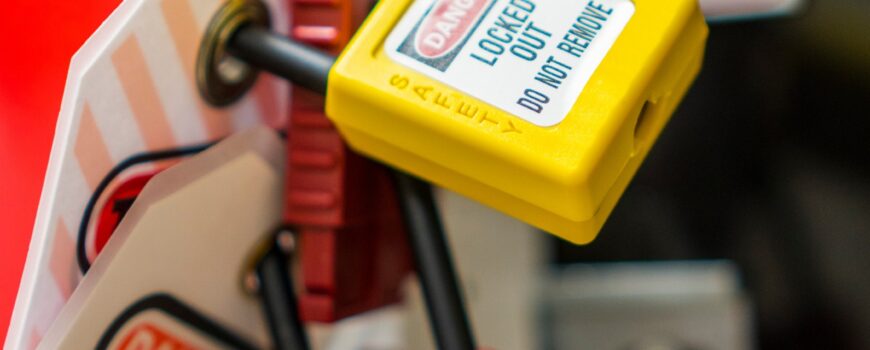
Choosing the right Lockout Tagout (LOTO) padlock is essential for preventing accidental machine start-ups and protecting employees during maintenance and servicing activities.
A safety lockout padlock may look like a simple device, but it plays a critical role in controlling hazardous energy in manufacturing plants, chemical facilities, pharmaceutical industries, power stations and offshore installations.
With different materials, shackle types, colours and keying systems available, selecting the right industrial safety padlock requires careful consideration.
In this guide, Lotomaster explains the key factors to consider when choosing the right Lockout Tagout padlock.
1. Choose the Right Padlock Material
The material of a safety padlock should match the working environment and application.
- Non-Conductive Padlocks:
Plastic or nylon shackles are suitable for applications where non-conductive properties are required, particularly electrical lockout. - Steel Shackle Padlocks:
Offer mechanical strength and durability for general industrial lockout applications. - Stainless Steel Shackle Padlocks:
Useful in demanding environments, including marine, offshore and chemical facilities, where corrosion resistance is important.
Always verify the manufacturer’s specifications before selecting a padlock for a particular environment.
2. Select the Correct Shackle Length
Shackle dimensions determine whether a padlock can properly fit the isolation device.
Consider:
- Shackle length and diameter.
- Compatibility with lockout hasps.
- Clearance around isolation points.
- Compatibility with circuit breaker and valve lockout devices.
Standard and long-shackle options are available for different industrial applications. For example, Lotomaster safety padlocks offer a standard 38 mm shackle option.
3. Understand the Key System
Selecting the correct key system is essential for employee accountability and effective lockout procedures.
- Keyed Different (KD)
Each padlock has a unique key. One key operates only its corresponding padlock. This is generally preferred for individual employee lockout. - Keyed Alike (KA)
Multiple padlocks can be operated using the same key. Useful when one authorised employee needs to secure multiple isolation points. - Master Keyed (MK)
Individual padlocks have separate keys, while an authorised master key can open designated locks.
The keying system should be designed to prevent employees from accessing or removing another employee’s personal lock.
4. Consider Colour Coding
Different padlock colours help identify employees, departments and maintenance activities.
Common colours include:
- Red – Maintenance.
- Yellow – Electrical.
- Blue – Contractors.
- Green – Operations.
- Orange – Mechanical.
- White – Supervisors.
These are examples rather than universal standards. Every facility should establish its own colour-coding procedure.
5. Look for Important Safety Features
When purchasing industrial safety padlocks, consider the following features:
- Key-retaining mechanism: Prevents key removal while the padlock is unlocked.
- Employee identification labels: Allow users to identify the person responsible for the lock.
- Precision-machined keys: Support reliable operation and key differentiation.
- Durable construction: Suitable for repeated industrial use.
- Multiple colour options: Help establish consistent workplace identification.
6. Ensure Compliance with LOTO Requirements
OSHA 29 CFR 1910.147 establishes requirements for hazardous energy control.
European facilities should also consider applicable national legislation and relevant standards, including EN ISO 14118.
Safety lockout padlocks should support an effective energy isolation programme through proper identification, standardisation and dedicated use.
Remember: A padlock alone does not guarantee safety. Proper shutdown, isolation of hazardous energy sources, dissipation of stored energy and verification of isolation are essential.
Lotomaster Safety Lockout Padlocks are available in the following countries in Europe:
Austria, Belgium, Bulgaria, Croatia, Republic of Cyprus, Czech Republic, Denmark, Estonia, Finland, France, Germany, Greece, Hungary, Ireland, Italy, Latvia, Lithuania, Luxembourg, Malta, Monaco, Netherlands, Poland, Portugal, Romania, Serbia, Slovakia, Slovenia, Spain, Sweden, and the United Kingdom.